From Creation to Christ
Explore 4,000 years of biblical history through the lens of Archbishop Ussher's landmark chronology
Biblical Figures
440+ biblical figures — full genealogies from Adam to the Apostles
Search Everything
👑 Genealogy of Christ
Two distinct genealogies of Jesus are recorded in the New Testament. Click any name to view their profile.
About This Explorer
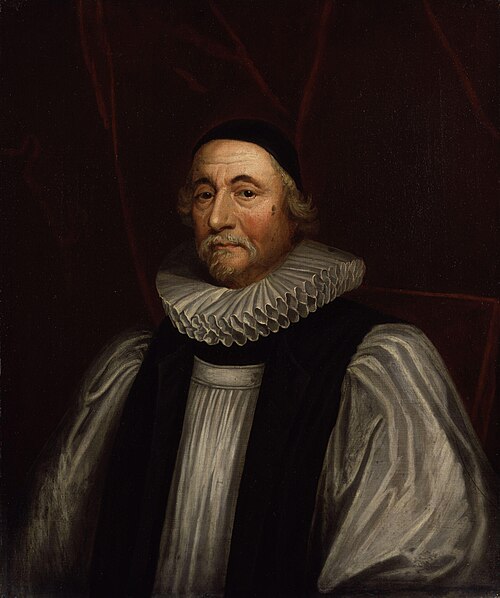
Painted by Sir Peter Lely, c.1654
Primate of All Ireland
Who Was James Ussher?
James Ussher (1581–1656) was the Church of Ireland Archbishop of Armagh and one of the most learned biblical scholars of the seventeenth century. Born in Dublin to a distinguished family with deep roots in the Irish church, he entered Trinity College Dublin at the age of thirteen — one of its first students — and went on to become one of the most formidable polymaths of his age. Fluent in Hebrew, Greek, Latin, Aramaic, Syriac, and Arabic, he built one of the greatest private libraries in Europe, corresponding with scholars across England, the Continent, and the Middle East to obtain ancient manuscripts and documents unavailable to most scholars of his time.
Unlike many of his contemporaries, Ussher did not confine himself to theology. He was equally at home in astronomy, ancient history, numismatics, patristics, and classical literature. He was a close friend of Sir Walter Raleigh, a trusted adviser to both James I and Charles I of England, and a central figure in the intellectual life of the British Isles during the most turbulent century in its religious history — spanning the reigns of Elizabeth I through Cromwell's Commonwealth.
His personal library of some 10,000 books and manuscripts — one of the finest in the British Isles — was sold to Oliver Cromwell's army after Ussher's death and became the foundation of the Library of Trinity College Dublin, where it still resides. He was buried in Westminster Abbey by Cromwell's personal order, despite being a Church of Ireland archbishop — testimony to the universal respect he commanded.
The Annals of the World (1650)
His magnum opus, Annales Veteris et Novi Testamenti (Annals of the Old and New Testament), published in Latin in 1650 and in English in 1658, proposed that Creation began on the evening before Sunday, October 23, 4004 BC — the Julian proleptic calendar date calculated from the genealogies of the Hebrew Masoretic Text, the books of Kings and Chronicles, and synchronisms with the independently verified dates of Babylonian, Persian, Greek, and Roman history.
Ussher's key anchor points include: the Flood at 2348 BC, the birth of Abraham at 2008 BC, the Exodus at 1491 BC, the founding of Solomon's Temple at 1012 BC, the Fall of Jerusalem to Babylon at 588 BC — a date confirmed by the Babylonian Chronicles — and the birth of Christ at 4 BC. His chronology was not a guess or a simple calculation from the plain text of Genesis alone; it was the product of decades of cross-referencing every chronological statement in Scripture against the annals of seven ancient civilisations.
The work was so thorough and so apparently authoritative that from 1701 it was printed in the margins of the King James Bible, where it remained the standard reference for readers for over two centuries. Many people who encountered the dates "4004 BC" at the top of Genesis never knew they were reading Ussher's independent scholarly calculation, not the text of Scripture itself.
Method
Ussher worked from multiple interlocking foundations. He began with the explicit chronological statements in Scripture — regnal years of Israelite and Judean kings in Kings and Chronicles — and cross-checked them against Babylonian king-lists confirmed by the Nabonassar astronomical era, Ptolemy's Canon, and the independently dated Eclipse of Thales (585 BC). Working backward through the divided monarchy, the United Kingdom period, Judges, Joshua, and the wilderness years, and then forward through the genealogies of Genesis — taking careful account of the Masoretic versus Septuagint textual traditions — he arrived at a date for Creation. He used the Julian calendar and anchored his year-count to Anno Mundi (AM — "Year of the World"), with AM 1 = the creation week.
Modern scholars, including many believing Christian scholars, reach different conclusions — often because they follow the longer genealogies of the Septuagint, give different weights to co-regencies in the Israelite monarchy, or accept different anchor dates from Babylonian records. The most detailed academic revision of the Kings/Chronicles chronology is Edwin Thiele's The Mysterious Numbers of the Hebrew Kings (1951/1983), which produces dates typically running 15-22 years later than Ussher for the divided monarchy period. This explorer notes Ussher's dates and, where relevant, the Septuagint (LXX) alternative dates.
Life Timeline
Legacy
Ussher's chronology occupied a unique position in Western intellectual history for nearly two centuries — regarded simultaneously as rigorous scholarship and sacred tradition. When Darwin's On the Origin of Species appeared in 1859, the Ussher chronology became a central battleground in the conflict between evolutionary geology and biblical literalism, a role Ussher himself could never have anticipated. In the 20th century it became associated with young-earth creationism, though Ussher himself was far more nuanced — he was a careful philologist and historian who understood that the Hebrew text had textual variants, that ancient chronology was difficult, and that scholarly consensus could change.
Whatever one's view of his conclusions, his Annals of the World represents a remarkable achievement: a systematic attempt to place the entire biblical narrative within a coherent and detailed world history, anchored to verifiable secular dates, in a way no previous scholar had achieved with such thoroughness. It stands as one of the great works of 17th-century scholarship.
Remarkable Chronological Facts
The chain of tradition from Creation to Moses. From Adam to Moses there are only five intervening links — six if Kohath is counted separately. The complete chain runs: Adam knew Methuselah (they overlapped by 243 years); Methuselah knew Shem (98 years of overlap); Shem knew Abraham (150 years of overlap); Abraham knew Jacob (roughly 15 years); Jacob knew his grandson Kohath (son of Levi); and Kohath knew Moses. These are not hypothetical links — by Ussher's chronology, each person in the chain was alive and adult while the next was born. The total span from Creation (4004 BC) to Moses' death (1451 BC) is 2,553 years — yet this entire sweep of human history could, in principle, have been carried through personal memory and testimony by just six individuals who actually knew one another. It is a significantly shorter chain of transmission than we possess for many events whose earliest surviving written account appears far later than their claimed date of occurrence.
The span of the Old Testament in numbers. The books of the Old Testament do not distribute their history evenly. By Ussher's reckoning, Genesis alone covers 2,369 years — from Creation (4004 BC) to the death of Joseph (1635 BC). The remaining 38 books of the Old Testament cover only 1,238 years, from Joseph's death to the close of the prophetic canon with Malachi (c.397 BC). The total span of Old Testament history is 3,607 years — a longer period than the entire interval between Malachi and the present day.
About This Tool
This explorer presents Ussher's chronology interactively, drawing on his published dates, Scripture references from the KJV tradition, cross-references from ancient historians (Josephus, Tacitus, Herodotus, Pliny, Eusebius, Berossus), archaeological confirmations, and links to the Bolls Bible API for live verse text. World history events from parallel civilisations are included to provide chronological context. The chronological framework of Ussher is presented on its own terms; where alternative scholarly dates or readings exist, they are noted for reference and comparison.
About the Author
This explorer was designed and built by Mathew Green (@Mwolltto), an Australian husband and father of eight, and a Ruling Elder in the Presbyterian Church of Australia. His interests include Reformed theology, biblical chronology, church history, and the biblical languages — the same combination of passions that makes Ussher's work so enduringly compelling.
This site is offered freely, with the hope that Ussher's remarkable seventeenth-century scholarship finds a wider audience in the digital age — and that it helps people engage more seriously and joyfully with Scripture and the history of redemption.
Images & Historical Artwork
This explorer includes paintings and illustrations by historical artists such as James Tissot, Gustave Doré, Rembrandt, Michelangelo, and Lucas Cranach. All images are public-domain works included for historical and artistic reference. Viewers should be aware of the following:
- Violence: Some works depict scenes of battle, execution, or sacrifice consistent with biblical narratives and the standards of their era.
- Nudity: Some classical and Renaissance paintings depict the human form in the nude, in keeping with the artistic conventions of their period. These are presented as historical documents, not for any other purpose.
- Depictions of Christ and God: Some historical paintings include artistic representations of God the Father, Christ, angels, or other divine figures. These images are included solely as historical and artistic records of how Christian artists visualised Scripture across the centuries. It must be stated plainly that no image produced by human hands can truly or fully represent the Lord Jesus Christ. His Word alone gives us the picture we need. Reformed theology — including the tradition of Ussher himself — has long held that the Second Commandment (Exodus 20:4–6) cautions against making or venerating images purporting to represent God. These works should be received as human artistic expressions of their age, not as devotional aids or likenesses.
Sources
Primary: Ussher, James. The Annals of the World (1650, English translation by Larry and Marion Pierce, 2003). Secondary: Thiele, Edwin R. The Mysterious Numbers of the Hebrew Kings (1983); Josephus, Antiquities of the Jews and Jewish Wars; Eusebius, Church History; Tacitus, Annals. Scripture text via Bolls.life Bible API. Archaeological data: British Museum, Oriental Institute Chicago, Israel Antiquities Authority.
Confessional Framework
James Ussher was not merely a chronologist — he was one of the foremost Reformed churchmen of the 17th century. As Archbishop of Armagh and Primate of All Ireland, he authored the Irish Articles of 1615, which became a direct precursor to the Westminster Confession of Faith (1647). Many scholars regard the Irish Articles as the theological matrix from which the Westminster Standards were drawn.
The Westminster Confession of Faith, produced by the Westminster Assembly in the 1640s, articulates the confessional foundation from which Ussher's chronological work should be understood. Several chapters bear directly on his project:
- Holy Scripture (WCF I): "The Old Testament in Hebrew … and the New Testament in Greek … being immediately inspired by God, and by his singular care and providence kept pure in all ages, are therefore authentical." It is on this ground that Ussher held Scripture's chronological data to be reliable and worth anchoring to secular history.
- Creation (WCF IV): "It pleased God the Father, Son, and Holy Ghost … in the beginning, to create … the world, and all things therein, whether visible or invisible, in the space of six days; and all very good." Ussher's calculation of a creation date of 4004 BC flows directly from taking this confession seriously alongside the Masoretic text's genealogical data.
- Providence (WCF V): God "upholds, directs, disposes, and governs all creatures, actions, and things, from the greatest even to the least." Ussher's entire chronological enterprise rests on the conviction that secular and sacred history form a single providential story — that the fall of Babylon in 539 BC and the reign of Solomon are threads in the same divine tapestry.
This site is built within that same confessional tradition. It presents Ussher's chronology as the work of a careful and faithful scholar who believed Scripture to be the supreme authority in all matters it addresses, including chronology. Alternative scholarly readings are noted where relevant, but the Ussher framework is presented on its own terms, not apologetically.
Privacy
This site collects no personal data. There are no tracking scripts, no analytics, no advertising networks, and no cookies beyond those required for the current browser session (used only to remember your display preferences such as theme). No information you enter or click is sent to any server — the site runs entirely in your browser from static files. No account is required. No data is retained when you close the tab.
